Quality assurance, guaranteed on every dataset.
Automated validation and expert human review, on every session, before anything ships to your training pipeline.
Checkable numbers, not adjectives
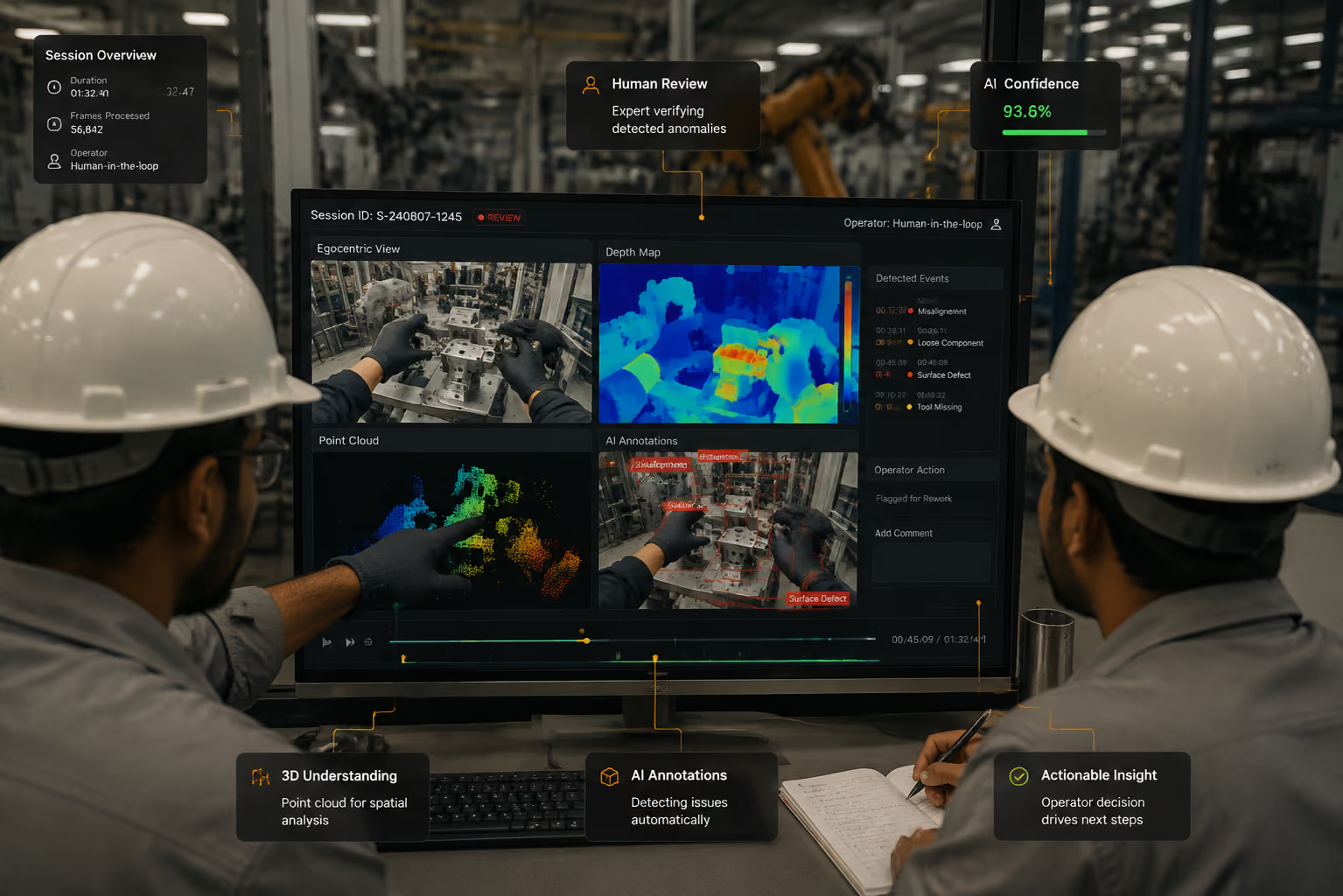
Reviewed onsite, not outsourced blind
Every session is reviewed by the team that ran the capture, not handed off to a disconnected queue. Calibration checks, operator drift, and sensor sync get caught the same day, by people who were in the room.
Manual review does not scale
Spot checking a handful of clips per batch misses the errors that actually break a policy. Frame drops, coordinate misalignment, and near duplicate demonstrations slip through quietly and show up later as training noise.
Every sequence gets validated
Every capture passes through automated checks and human review before it is ever packaged for delivery, with a documented trail connecting raw capture to shipped dataset.
Four steps, speed without cutting corners
Automated checks catch it first. Human reviewers catch what automation can't. Nothing ships without both.
Automated validation
Every session is checked on ingest for framing, lighting, focus, and completeness before a human ever sees it.
VLM first-pass QA
Vision-language models triage every submission fast, flagging likely issues before a reviewer opens the sequence.
Expert human review
Full QC is still applied to the depth your project needs. Automation speeds it up, it does not replace it.
Recapture, not ship
Anything short of the bar gets recaptured, not shipped. Nothing sub-standard reaches your pipeline.
Failure modes we screen for
Here's what that VLM triage step catches before a reviewer ever opens the sequence.
Action sequencing
Flags demonstrations where steps are skipped, reordered, or padded out to hit a target length.
Contact drift
Detects gripper and end-effector poses that drift outside the tolerance defined for the task.
Sensor dropout
Surfaces missing or corrupted frames, timestamp gaps, and sensor desync within a sequence.
Redundant captures
Screens out near duplicate demonstrations that add storage cost without adding real coverage.
Infrastructure most competitors don't mention
Quality checks are only as good as how fast they reach you after capture.
High-speed connectivity
Every collection site runs on high-speed internet, footage syncs fast, not overnight.
Faster QA turnaround
QA starts sooner after capture, so issues get caught while sessions are still fresh.
Faster iteration for you
Capture → upload → QA → feedback → recapture, tighter end to end.
See the quality report before you receive the data
Every delivery ships with a report covering pass rate, flagged sequences, and calibration status by session, so you know what you are training on before it touches your pipeline.
- Pass rate by batch and by operator
- Flagged sequences with the reason they were held back
- Calibration status for every sensor rig used
Trial to production
Most teams move through four stages before quality data is shipping on a steady cadence.
Pilot batch
A small capture run validates the protocol against your actual task before we scale collection.
Calibration review
We walk through the pilot results together and adjust thresholds before committing to volume.
Scaled collection
Full production capture runs against the validated protocol, with the same checks applied at scale.
Continuous delivery
Ongoing batches ship on your schedule, each with its own quality report attached.
Full traceability
Every frame traces back to its operator, session, and calibration record.
Automated and human review
Automated checks catch the obvious. Reviewers catch the subtle.
Flexible integration
Dataset formats and delivery cadence built around your training stack.